 Misalee Ali Saeed, 15 year old Ethiopian human rights activist, appears on Canadian television as one of Winnipeg's city heros.
City Hero (watch the TV clip from CITY TV )
Misalee's website, Abugida
Misalee Ali Saeed, 15 year old Ethiopian human rights activist, appears on Canadian television as one of Winnipeg's city heros.

 ...In testimony before the House Subcommittee on Africa, Global Human Rights and International Operations, [Deputy Assistant Secretary of State] Yamamoto said, "It is incumbent upon Prime Minister Meles, his government and the various elements of the multifaceted opposition to demonstrate to the world, but, more importantly, to Ethiopians, the sincerity of their professed commitment to democracy through their actions as well as their words."
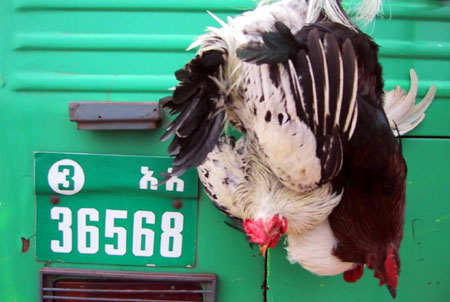 So far in Africa, the H5N1 virus linked to the dreaded avian flu (bird flu) has been detected in Nigeria, Niger, Egypt and most recently, Cameroon. No human cases of the H5N1 strain have yet been found in Africa. Late last month, the Ethiopian Ministry of Agriculture and Rural Development disclosed signs of avian flu had been observed in Endibir woreda of the South State. Subsequent samples sent to a laboratory in Italy turned out to be negative for the existence of a bird-flu-like disease, but the damage was already evident in the poultry market with chickens reportedly selling for as low as 8 Birr, previously 35 Birr.
 Yet more discovery of bones in Ethiopia linking origins of humans to apes...And this smart brother from the appropriately named Stone Age Institute knew well enough to bring his team to Ethiopia, birthplace of mankind, yet a place still operating with Stone Age mentality.
 An earlier post regarding Ethiopian Customs Authority stirred some people (apparently someone reads my rantings) to e-mail their own experiences, and what they dread each time they land in Addis. High on the list was being directed to that special window where you may empty your wallet paying import taxes on an extra electronic gadget found in your luggage. I for one recall an old cell phone stuffed into my carry-on luggage as I rushed to catch my plane, cost several times what I paid for it on arrival in Addis, at least according to the gumruk bible the lady kept looking at. Jetlagged and furious, I was just about to open my mouth, when she took another look at the phone, and with a "Aha, k'oy ande...," she turned and began punching a few keys into a computer. I thought, surely, she realized her mistake and will return with a more sensible figure, but I was forgetting where I was. Lesson number one: Having hope in Ethiopia is a set-up for bitter disappointment, at least with official matters. My beat-up cell phone had a built in camera (standard nowadays) which did not even work after being dropped one too many times, but would now cost twice the earlier quote, argh! There goes my vacation money. And here's the kicker, I could either leave the phone with Customs, or take the phone out the airport, but either way I had to pay the same full amount...Huh? Lesson number two: Never ask why to Ethiopian government workers, they take it personal.
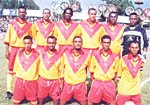 St. George's 4-0 shocking defeat on Sunday of former champions Hearts of Oak in the African Champions League caused such excitement, one could presumably forget, if not but for a fleeting moment, the trials which had befallen the city in the past few months. The Ethiopian club's second round defeat of the Ghanaian squad followed the stir they caused in the first round last month with their 1-0 victory over the Egyptian club ENPPI. Lack of talent was never Ethiopia's problem, but rather sound financial backing. Ethiopia was a founding member and previous champion of the African Nations Cup...But I'm sure we're all tired of living in the past. With support from their current billionaire patron, Saudi-Ethiopian business tycoon Sheik Al-amoudi, St. George may well be poised to restore Ethiopia's long forgotten football credentials. Viva Georgis!
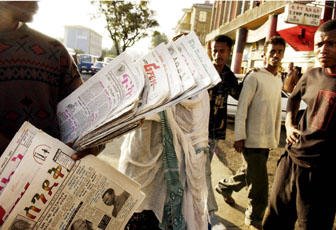 Two steps forward and three steps back, the country moves from a climate of high hopes and open debates, back to one of fear and suspicion.
