Mimi Sebhatu wins all the stakes in Ethiopia
Indian Ocean Newsletter N° 1169 18/02/2006
After having been one of the three firms to be short listed last year by the Ethiopian Broadcasting Agency (EBA) (ION 1133), Zami Public Connection is one of the lucky two winners of a license to operate a radio station on the FM waveband. This firm has good contacts with the current regime in Ethiopia. It is owned by the former reporter on Voice of America (VOA) Mimi Sebhatu and her husband Zerihun Teshome, who is also the general manager of the weekly publication in the Amharic language Iftin. The couple passes on the viewpoints of the Ethiopian authorities into the journalistic circles in Addis Ababa and to Ethiopians abroad. The second FM license was awarded to Tisae Fine Arts & Adei Promotion owned by the actor Abebe Balcha and his partners.
Dereje Bekele promoted
Indian Ocean Newsletter N° 1168 11/02/2006
The former independent MP Dereje Bekele has just obtained an official post. Bekele had joined the Oromo Federalist Democratic Movement (OFDM, opposition), led by Bulcha Demeksa, during the May 2005 elections, but was later expelled from the party. Last month he was appointed advisor on rural development issues to the office of Abadula Gemeda, the former Minister of Defence and the current head of the Oromia Regional State. Bekele had been a deputy minister on Oromia matters reporting to the office of the Ethiopian Prime Minister during the transition regime at the beginning of the 1990s and subsequently worked for the Ethiopian Coffee and Tea Corporation. After that, he distanced himself from the Ethiopian regime while nevertheless remaining a moderate opponent. He therefore quickly came into dispute with Demeksa and other OFDM leaders who accused him of supporting the government because he held the OFDM responsible for the current instability in the Oromia region. The OFDM then expelled him. He has now rallied behind Gemeda, who is the head of the Oromo People Democratic organizationon (OPDO, member of the governing coalition). This lends credence to Bekele's detractors who accuse him of wanting to turn the OFDM into a branch of the OPDO.
Meles Zenawi invites Louis Michel
Indian Ocean Newsletter N° 1169 18/02/2006
During his recent visit to Brussels, the Prime Minister of Ethiopia invited the European Commissioner Louis Michel to Addis Ababa.
The European Commissioner for Development Louis Michel is trying to take advantage of the momentum built up by the visit to Brussels on 4 February by the Ethiopian Prime Minister Meles Zenawi (ION 1168) to continue peace talks. During the visit, Zenawi invited Michel to Addis Ababa to see the situation in his country for himself. Michel considered his decision carefully and set a condition to accepting the invitation: that he be allowed to visit the imprisoned opposition leaders. The Ethiopian authorities gave their agreement on this point and Michel went to Addis Ababa from 15 to 17 February. He is to have a long meeting with Meles Zenawi on 16 February and then to go on to interview the political prisoners in the prison in Addis, making him the first foreign political official to do so. Michel should also have meetings with MPs, the families of political prisoners and the representatives of the European Union and the United States in Addis Ababa.
Michel aims to discuss with the Ethiopian authorities about the conditions for freeing the political prisoners, or at least bringing them to trial. It would appear that only the second option will be retained, as the Ethiopian Prime Minister is still staying firmly entrenched in his position on the imprisonment of the leaders of the Ethiopian opposition. In that case, the European Commissioner had planned to seek for the in-principle approval of having international observers to ensure a fair trial of these opposition members. A source at the European Commission in Brussels this week told The Indian Ocean Newsletter that the European Union may envisage discussing the resumption of its aid to Ethiopia. But that would be only after the Ethiopian authorities have given their assurances on this point of the presence of international observers at the opposition leaders' trial and the resumption of dialogue between the Ethiopian government and its political opposition.
Two American Democrat Congressmen support Asmara
Indian Ocean Newsletter N° 1169 18/02/2006
Two American Congressmen, members of the Democratic Party (DP) James P. Moran (Virginia) and Betty McCollun (Minnesota) this week brought their support to the Organization of Eritrean-Americans (OEA) which is waging a campaign for Ethiopia to implement the border agreement with Eritrea. The OEA organized a demonstration on 13 February in front of the US State Department to put pressure on the United States, the main witness to the Algiers agreement to have the 2002 ruling by Eritrean-Ethiopian Boundary Commission (EEBC) applied. Created in 1998 and based in Washington DC, the OEA sees itself as the voice of Eritrea to the American Administration and media. Betty McCollun, who is a member of the House of Representatives Subcommittee on Africa Global Human Rights and International Operations, and James P. Moran sent the OEA a letter in which they both congratulated its members for bringing such a large group together at this demonstration.
Monday, February 20, 2006
Thursday, February 16, 2006
Banned Ethiopian clear to compete
 Teklemariam has been cleared to compete in Turin, after his five-day suspension was lifted by the International Skiing Federation (FIS).
 He was one of 12 athletes banned for high levels of haemoglobin, but a new blood test has given him the all clear.
Teklemariam, Ethiopia's first ever Winter Olympian, will take part in Friday's 15km, next Wednesday's sprint and the 50km on Saturday 25 February...
Banned Ethiopian clear to compete (BBC) 15 February, 2006


ION Update: 02/16/06
A discreet visit to Brussels
Indian Ocean Newsletter N° 1168 11/02/2006
At his request, the Prime Minister of Ethiopia has had a meeting at a secret location in Brussels with the European Commissioner for Development, Louis Michel.
Prime Minister Meles Zenawi of Ethiopia went to Brussels on 4 February, on a surprise visit to the European Commissioner for Development, Louis Michel. Their meeting was held at a secret location in the Belgian capital in order to avoid demonstrations by opponents to the regime. Also present at the meeting were the Ethiopian Ambassador to Brussels Berhane Gebre-Christos and the leader of the European Union (EU) delegation to Addis Ababa, Tim Clarke. Meles Zenawi’s visit to Brussels was not listed in the European Commissioner’s diary. In fact, the Ethiopian Prime Minister came at the last minute in the hope of obtaining a resumption of European aid (461 million euros for the period 2002-2007), particularly in funds for the Ethiopian budget.
However, the Ethiopian opposition got wind of this meeting before it took place. On 3 February, the European Commissioner’s electronic inbox was flooded with e-mails denouncing the repression of opponents in Ethiopia. A delegation from the Joint Civic and Political Task Force of Ethiopians in Europe even went to Michel’s home to hand him a letter signed by its representatives Gebeyaw Nigussie, Dadimos Haile and Abebe Bogale, which included a reminder of the resolution adopted on 15 December 2005 by the European Parliament. This text called for the immediate and unconditional freeing of political prisoners, for a commission to be set up to investigate violations of human rights and to investigate frauds committed during the May 2005 election and also for sanctions to be taken against members of the Addis Ababa regime.
The message would appear to have got through, because Michel told the Ethiopian Prime Minister that the present situation suited no-one and that any resumption of political dialogue with the EU supposed that the Ethiopian opposition would be treated in a manner customary in a democratic State. Louis Michel also made a plea for the freeing of political prisoners. “We did not want to discuss aid. It is not on the agenda. We will discuss it when political dialogue has resumed” the European Commissioner’s spokesman told The Indian Ocean Newsletter. However, the European Commission felt Meles Zenawi’s wanting to discuss his country’s situation with it to be “positive”. The European Commission even considers that it is the sole international institution with which Meles Zenawi still wants to keep a discussion channel open. It hopes to obtain from him a road map for bringing the situation in his country back to normality.
ACP-EU assembly mission cancelled at the last minute
Indian Ocean Newsletter N° 1168 11/02/2006
A mission that was to have gone to Eritrea and then on to Ethiopia, was cancelled on 3 February 2006, just two days before it was scheduled to leave for Asmara. This mission should have been led by the Co-Presidents of the ACP-EU Joint Parliamentary Assembly (JPA), Glenys Kinnock from the United Kingdom and Georges Rawiri from Gabon. The reason for the sudden cancellation was that President Isayas Afeworki refused to receive the delegation. On the Eritrean side, the explanation is that the government of Asmara has nothing in particular against the JPA, but that over the last four years all of the visits by foreign delegations have produced nothing positive concerning the border dispute with Ethiopia and they have constituted a “waste of resources”. However, last week Eritrea decided to close its embassy in Brussels “for financial reasons” and transfer the corresponding jurisdiction concerning relations with the European Union (EU) to its embassy in The Netherlands. This illustrates the nature of Eritrean feeling about the European Union. The government of Asmara considers that the EU has not applied enough pressure on the government of Ethiopia to oblige it to accept the border defined by the International Court of Justice. Meanwhile, relations between the European Parliament and Ethiopia fare hardly any better. The same 3 February, the Ethiopian Ambassador Berhane Gebre-Christos informed the European Parliament that the Ethiopian portion of the mission had been cancelled. This time, the pretext given was the last minute announcement by the ACP countries, on 2 February, that they would not be sending anyone to take part in the JPA delegation to Ethiopia due to “financial difficulties” in their group. Although Ms Kinnock stated that she intended to go to Addis Ababa in any case, the Ethiopian officials informed the European Parliament that without the presence of representatives from the ACP countries, the mission had lost all of its “joint” character and therefore “no longer had any point”. The view widely held inside the circles of the Ethiopian opposition and the European Parliament, is that Addis Ababa had taken this decision in reprisal to the preliminary report on the 2005 elections written by the mission of European observers led by the Portuguese Socialist MEP Ana Gomes.
Indian Ocean Newsletter N° 1168 11/02/2006
At his request, the Prime Minister of Ethiopia has had a meeting at a secret location in Brussels with the European Commissioner for Development, Louis Michel.
Prime Minister Meles Zenawi of Ethiopia went to Brussels on 4 February, on a surprise visit to the European Commissioner for Development, Louis Michel. Their meeting was held at a secret location in the Belgian capital in order to avoid demonstrations by opponents to the regime. Also present at the meeting were the Ethiopian Ambassador to Brussels Berhane Gebre-Christos and the leader of the European Union (EU) delegation to Addis Ababa, Tim Clarke. Meles Zenawi’s visit to Brussels was not listed in the European Commissioner’s diary. In fact, the Ethiopian Prime Minister came at the last minute in the hope of obtaining a resumption of European aid (461 million euros for the period 2002-2007), particularly in funds for the Ethiopian budget.
However, the Ethiopian opposition got wind of this meeting before it took place. On 3 February, the European Commissioner’s electronic inbox was flooded with e-mails denouncing the repression of opponents in Ethiopia. A delegation from the Joint Civic and Political Task Force of Ethiopians in Europe even went to Michel’s home to hand him a letter signed by its representatives Gebeyaw Nigussie, Dadimos Haile and Abebe Bogale, which included a reminder of the resolution adopted on 15 December 2005 by the European Parliament. This text called for the immediate and unconditional freeing of political prisoners, for a commission to be set up to investigate violations of human rights and to investigate frauds committed during the May 2005 election and also for sanctions to be taken against members of the Addis Ababa regime.
The message would appear to have got through, because Michel told the Ethiopian Prime Minister that the present situation suited no-one and that any resumption of political dialogue with the EU supposed that the Ethiopian opposition would be treated in a manner customary in a democratic State. Louis Michel also made a plea for the freeing of political prisoners. “We did not want to discuss aid. It is not on the agenda. We will discuss it when political dialogue has resumed” the European Commissioner’s spokesman told The Indian Ocean Newsletter. However, the European Commission felt Meles Zenawi’s wanting to discuss his country’s situation with it to be “positive”. The European Commission even considers that it is the sole international institution with which Meles Zenawi still wants to keep a discussion channel open. It hopes to obtain from him a road map for bringing the situation in his country back to normality.
ACP-EU assembly mission cancelled at the last minute
Indian Ocean Newsletter N° 1168 11/02/2006
A mission that was to have gone to Eritrea and then on to Ethiopia, was cancelled on 3 February 2006, just two days before it was scheduled to leave for Asmara. This mission should have been led by the Co-Presidents of the ACP-EU Joint Parliamentary Assembly (JPA), Glenys Kinnock from the United Kingdom and Georges Rawiri from Gabon. The reason for the sudden cancellation was that President Isayas Afeworki refused to receive the delegation. On the Eritrean side, the explanation is that the government of Asmara has nothing in particular against the JPA, but that over the last four years all of the visits by foreign delegations have produced nothing positive concerning the border dispute with Ethiopia and they have constituted a “waste of resources”. However, last week Eritrea decided to close its embassy in Brussels “for financial reasons” and transfer the corresponding jurisdiction concerning relations with the European Union (EU) to its embassy in The Netherlands. This illustrates the nature of Eritrean feeling about the European Union. The government of Asmara considers that the EU has not applied enough pressure on the government of Ethiopia to oblige it to accept the border defined by the International Court of Justice. Meanwhile, relations between the European Parliament and Ethiopia fare hardly any better. The same 3 February, the Ethiopian Ambassador Berhane Gebre-Christos informed the European Parliament that the Ethiopian portion of the mission had been cancelled. This time, the pretext given was the last minute announcement by the ACP countries, on 2 February, that they would not be sending anyone to take part in the JPA delegation to Ethiopia due to “financial difficulties” in their group. Although Ms Kinnock stated that she intended to go to Addis Ababa in any case, the Ethiopian officials informed the European Parliament that without the presence of representatives from the ACP countries, the mission had lost all of its “joint” character and therefore “no longer had any point”. The view widely held inside the circles of the Ethiopian opposition and the European Parliament, is that Addis Ababa had taken this decision in reprisal to the preliminary report on the 2005 elections written by the mission of European observers led by the Portuguese Socialist MEP Ana Gomes.
Sunday, February 12, 2006
Blair meets Meles
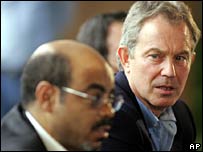 The UK Prime Minister, Tony Blair, has said he wants to see Ethiopia resolve its internal problems and continue on a democratic path.
…"The government won the election, there was then a reaction to it, there was then, perhaps, if I can say this without being too undiplomatic, an over reaction to that, which often happens," said Mr Blair.
"We have to try and resolve the situation, the human rights issues, but do so - and I want to do so - in a way that supports Ethiopia."
Mr Zenawi said if there had been flaws, Ethiopia would learn from its mistakes and move on. He respected Britain's decision to withhold government aid.
UK PM targets Ethiopia at summit (BBC) 12 February, 2006
Wednesday, February 08, 2006
Ethiopia's First Winter Olympian
 A little history for those who may be skeptic. In their first winter games (1988), Jamaica's bobsled team was seen as a novelty as they had many technical difficulties, injuries and crashes. In the second games (1992) the team had drastically improved. The 4-man team came in 14th ahead of the US, French, Russian and Italian teams, while in the 2-man event the Jamaican team shocked the world by beating the Swedish national champions and coming in 10th place. No matter where he places at the finish line, Robel is a first for Ethiopia. Ski, Robel, Ski!
PRAGELATO, Italy (Reuters) - With his black skin and long dreadlocks, Robel Teklemariam stands out from the other cross-country skiers at the Turin Olympics.
But next Friday, he will line up alongside them for the men's 15 km classical race to become the first Ethiopian to compete at the Winter Olympic Games.
Ethiopia's Robel with a cause at Turin Olympics (Reuters) Feb 8, 2006
Struggling to end food aid
 ADDIS ABABA, 7 Feb 2006 (IRIN) - There is a joke told in Ethiopia that encapsulates the country's struggle with food aid dependency. In it, two subsistence farmers are talking about the year's poor rains and the impact on their harvests.
The older, his face and hands worn from a lifetime of hard work, turns to his younger friend and offers some advice: "It is not the rains in Ethiopia you need to worry about, but whether it rains in America or Canada."
For the last three decades, millions of Ethiopians have depended on food aid from the donors. Each year, regardless of harvests or rains, at least five million Ethiopians need food aid for six months to survive...
ETHIOPIA: Struggling to end food aid dependency (IRIN) Feb 7, 2006
Monday, February 06, 2006
ION update: 02/06/06
Mediators to the rescue
Indian Ocean Newsletter N° 1167 04/02/2006
In its efforts to calm the opposition and soften the Ethiopian regime, American diplomacy is now calling on university professors to act as mediators.
Professor Donald Levine of the University of Chicago has been in Addis Ababa for a few weeks and was recently authorised by the penitentiary administration to meet the leaders of the Congress for Unity and Democracy Party (CUDP, opposition) in Kaliti prison where they are being held. Before that, this professor of sociology, a specialist in Ethiopian affairs, had met with officials from the Ethiopian government.
In a message sent at the beginning of the year to the ethiopundit web site, Levine stated that he wanted to see Ethiopia move in a new direction in 2006 in which “old hatreds give way to new possibilities of living together harmoniously”. At the same time he announced that he was intending to go to Ethiopia on 7 January for several weeks, “to promote some movement in this direction”. In Addis Ababa, his intention was “to attempt to meet with leaders from all sides”. Afterwards, he should go to the south of the country to inaugurate the Awassa Peace Center on 5 February, as The Indian Ocean Newsletter had already announced (ION 1164).
This move is part of a strategy devised by the United States deputy assistant secretary of state for African affairs, Donald Yamamoto, to use the services of Levine and another intellectual specialised in Ethiopia, Paul Henze, to try to influence both sides of the Ethiopian political conflict. The idea is hence to embark on route to compromise which could lead to the freeing of the opposition leaders and the latter accepting to take up their seats in the Federal Parliament and lifting the order to boycott the institutions and other civil resistance actions.
Meles Zenawi’s new advisor
Indian Ocean Newsletter N° 1167 04/02/2006
Annette Scheckler, the former head of Voice of America’s (VOA) Horn of Africa service, has become a new special political advisor to Prime Minister Meles Zenawi. Scheckler has been in conflict with VOA since she left the station a few years ago. No official announcement has been made about her new position, but according to information obtained by The Indian Ocean Newsletter in Addis Ababa, this is indeed the case. In fact, Scheckler has just gone to the Ethiopian capital to negotiate the terms of her employment and will subsequently be based at the Ethiopian embassy in Washington, while nevertheless reporting directly to the Ethiopian Minister of Foreign Affairs Seyoum Mesfin. Her work should consist of lobbying American officials in favour of the Ethiopian government. This contract is believed to be the result of an intervention in her favour by one of her friends, Igigayehou “Mimi” Sebhatu, who is a journalist close to the Ethiopian regime. Sebhatu was formerly a VOA reporter in the United States and founded the company Zami Public Connection in Addis Ababa with her husband (ION 1133). Scheckler is the wife of an Ethiopian former member of the Ethiopian People’s Revolutionary Party (EPRP, opposition), whose first name is Dawit who committed suicide last year. She had been in conflict with an Africa executive of VOA, the Ethiopian Negussie Mengesha whom she accused of being a member of the Ethiopian opposition. Ousted from VOA in 1998, she released a twenty page letter to the public in which she contested VOA’s decision and attacked Negussie Mengesha (ION 855).
Chaos in the customs
Indian Ocean Newsletter N° 1167 04/02/2006
There have recently been some sackings in various departments of the tax administration.
Last week, the new minister of revenue sacked the general manager of the Federal Inland Revenue Authority (FIRA), Woldegabriel Naizghi. The latter was a protégé of the previous Minister of Revenue Getachew Belay who was not retained in his functions in the cabinet reshuffle last year after being beaten in the Parliamentary elections in May 2005. Woldegabriel Naizghi was considered a close ally of Getachew Belay and opponents had in the past gone as far as criticising his alleged Eritrean origin. He also holds an American Green Card (which gives the holder the right of permanent abode in the USA) won in the annual lottery and had gone to the United States a year ago to renew his residence card.
In the wave of dismissals, the general manager of the Ethiopian Custom Authority (ECA), Damtew Demissie was also sacked and replaced by Bogale Negash, the former chief of administration (a sort of mayor) of the Jimma Special Zone. Bogale Negash is a member of the executive of the Oromo People’s Democratic Organisation (OPDO, a component in the government coalition). Solomon Gebreamlak, the head of the intelligence department of the FIRA, was also sacked from his post. A member of the Tigray People’s Liberation Front (TPLF, hard core of the EPRDF in power in Addis Ababa), he is also chairman of the Ethiopian Mineral Development Share Company (EMDSC), the only State firm active in the mining sector.
Indian Ocean Newsletter N° 1167 04/02/2006
In its efforts to calm the opposition and soften the Ethiopian regime, American diplomacy is now calling on university professors to act as mediators.
Professor Donald Levine of the University of Chicago has been in Addis Ababa for a few weeks and was recently authorised by the penitentiary administration to meet the leaders of the Congress for Unity and Democracy Party (CUDP, opposition) in Kaliti prison where they are being held. Before that, this professor of sociology, a specialist in Ethiopian affairs, had met with officials from the Ethiopian government.
In a message sent at the beginning of the year to the ethiopundit web site, Levine stated that he wanted to see Ethiopia move in a new direction in 2006 in which “old hatreds give way to new possibilities of living together harmoniously”. At the same time he announced that he was intending to go to Ethiopia on 7 January for several weeks, “to promote some movement in this direction”. In Addis Ababa, his intention was “to attempt to meet with leaders from all sides”. Afterwards, he should go to the south of the country to inaugurate the Awassa Peace Center on 5 February, as The Indian Ocean Newsletter had already announced (ION 1164).
This move is part of a strategy devised by the United States deputy assistant secretary of state for African affairs, Donald Yamamoto, to use the services of Levine and another intellectual specialised in Ethiopia, Paul Henze, to try to influence both sides of the Ethiopian political conflict. The idea is hence to embark on route to compromise which could lead to the freeing of the opposition leaders and the latter accepting to take up their seats in the Federal Parliament and lifting the order to boycott the institutions and other civil resistance actions.
Meles Zenawi’s new advisor
Indian Ocean Newsletter N° 1167 04/02/2006
Annette Scheckler, the former head of Voice of America’s (VOA) Horn of Africa service, has become a new special political advisor to Prime Minister Meles Zenawi. Scheckler has been in conflict with VOA since she left the station a few years ago. No official announcement has been made about her new position, but according to information obtained by The Indian Ocean Newsletter in Addis Ababa, this is indeed the case. In fact, Scheckler has just gone to the Ethiopian capital to negotiate the terms of her employment and will subsequently be based at the Ethiopian embassy in Washington, while nevertheless reporting directly to the Ethiopian Minister of Foreign Affairs Seyoum Mesfin. Her work should consist of lobbying American officials in favour of the Ethiopian government. This contract is believed to be the result of an intervention in her favour by one of her friends, Igigayehou “Mimi” Sebhatu, who is a journalist close to the Ethiopian regime. Sebhatu was formerly a VOA reporter in the United States and founded the company Zami Public Connection in Addis Ababa with her husband (ION 1133). Scheckler is the wife of an Ethiopian former member of the Ethiopian People’s Revolutionary Party (EPRP, opposition), whose first name is Dawit who committed suicide last year. She had been in conflict with an Africa executive of VOA, the Ethiopian Negussie Mengesha whom she accused of being a member of the Ethiopian opposition. Ousted from VOA in 1998, she released a twenty page letter to the public in which she contested VOA’s decision and attacked Negussie Mengesha (ION 855).
Chaos in the customs
Indian Ocean Newsletter N° 1167 04/02/2006
There have recently been some sackings in various departments of the tax administration.
Last week, the new minister of revenue sacked the general manager of the Federal Inland Revenue Authority (FIRA), Woldegabriel Naizghi. The latter was a protégé of the previous Minister of Revenue Getachew Belay who was not retained in his functions in the cabinet reshuffle last year after being beaten in the Parliamentary elections in May 2005. Woldegabriel Naizghi was considered a close ally of Getachew Belay and opponents had in the past gone as far as criticising his alleged Eritrean origin. He also holds an American Green Card (which gives the holder the right of permanent abode in the USA) won in the annual lottery and had gone to the United States a year ago to renew his residence card.
In the wave of dismissals, the general manager of the Ethiopian Custom Authority (ECA), Damtew Demissie was also sacked and replaced by Bogale Negash, the former chief of administration (a sort of mayor) of the Jimma Special Zone. Bogale Negash is a member of the executive of the Oromo People’s Democratic Organisation (OPDO, a component in the government coalition). Solomon Gebreamlak, the head of the intelligence department of the FIRA, was also sacked from his post. A member of the Tigray People’s Liberation Front (TPLF, hard core of the EPRDF in power in Addis Ababa), he is also chairman of the Ethiopian Mineral Development Share Company (EMDSC), the only State firm active in the mining sector.
Wednesday, February 01, 2006
Selassie I on Meet the Press
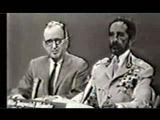 Selassie I on Meet the Press is another in a collection of old video footage of Haile Selassie, this time on a visit to the U.S. in the early sixties. Watch the emperor answer questions posed by reporters on Meet the Press, the television newshour still broadcast today. Questions regarding the newly formed OAU, Kennedy's ongoing fight with civil rights in America's South, and Africa's struggle to rid itself of colonialism are some of the questions posed to the emperor.
Meles rejects abuse accusations
...Meles, in an interview with Reuters, scoffed at the Amnesty report as based on second-hand, biased information.
...Amnesty said those detained had reportedly been accused of links with the Oromo Liberation Front, an opposition group fighting for independence in the southwestern region, although none has yet been charged.
Ethiopia's Information Ministry also ridiculed the Amnesty report, saying 86 students had been arrested "in compliance with the laws of our country" for throwing bombs, breaking property and disrupting classes.
"The news disseminated by Amnesty International that thousands of students are detained in Ethiopia is misinforming and incredible," the ministry added in a statement.
..."It's not a fair criticism," Meles said of the reports. "It's this type of sloppy reporting and, coupled with that, the vilification of the government by supporters of the opposition involved in the street action, that has distorted the image of Ethiopia."
Ethiopia's Meles rejects abuse accusations (Reuters) February 1, 2006
...Amnesty said those detained had reportedly been accused of links with the Oromo Liberation Front, an opposition group fighting for independence in the southwestern region, although none has yet been charged.
Ethiopia's Information Ministry also ridiculed the Amnesty report, saying 86 students had been arrested "in compliance with the laws of our country" for throwing bombs, breaking property and disrupting classes.
"The news disseminated by Amnesty International that thousands of students are detained in Ethiopia is misinforming and incredible," the ministry added in a statement.
..."It's not a fair criticism," Meles said of the reports. "It's this type of sloppy reporting and, coupled with that, the vilification of the government by supporters of the opposition involved in the street action, that has distorted the image of Ethiopia."
Ethiopia's Meles rejects abuse accusations (Reuters) February 1, 2006
'Thousands arrested' in Ethiopia
 Ethiopia has arrested thousands of members of the Oromo ethnic group over the past three months, according to Amnesty International.
The London-based human rights group said students were among those who have been rounded up since November.
Amnesty said the arrests follow protest calls by the rebel Oromo Liberation Front against alleged government fraud.
..."Those detained have reportedly been accused of links with the OLF, although none of them has yet been charged," it said.
It called on Ethiopian authorities to either charge or release the detainees and investigate alleged mistreatment of some of those held.
Meanwhile, the US-based Committee to Protect Journalists (CPJ) said Frezer Negash, an online journalist for the Ethiopian Review, had been arrested on Friday and was being held without charge in Addis Ababa.
'Thousands arrested' in Ethiopia (BBC News) February 1, 2006
Subscribe to:
Posts (Atom)
